The Los Angeles Bitcoin Mint Zine
The Los Angeles Bitcoin Mint is an art collective that offers artists a public forum for their art and the opportunity to permanently preserve it in a collection cataloged on the Bitcoin Ledger.
ISSUE 01
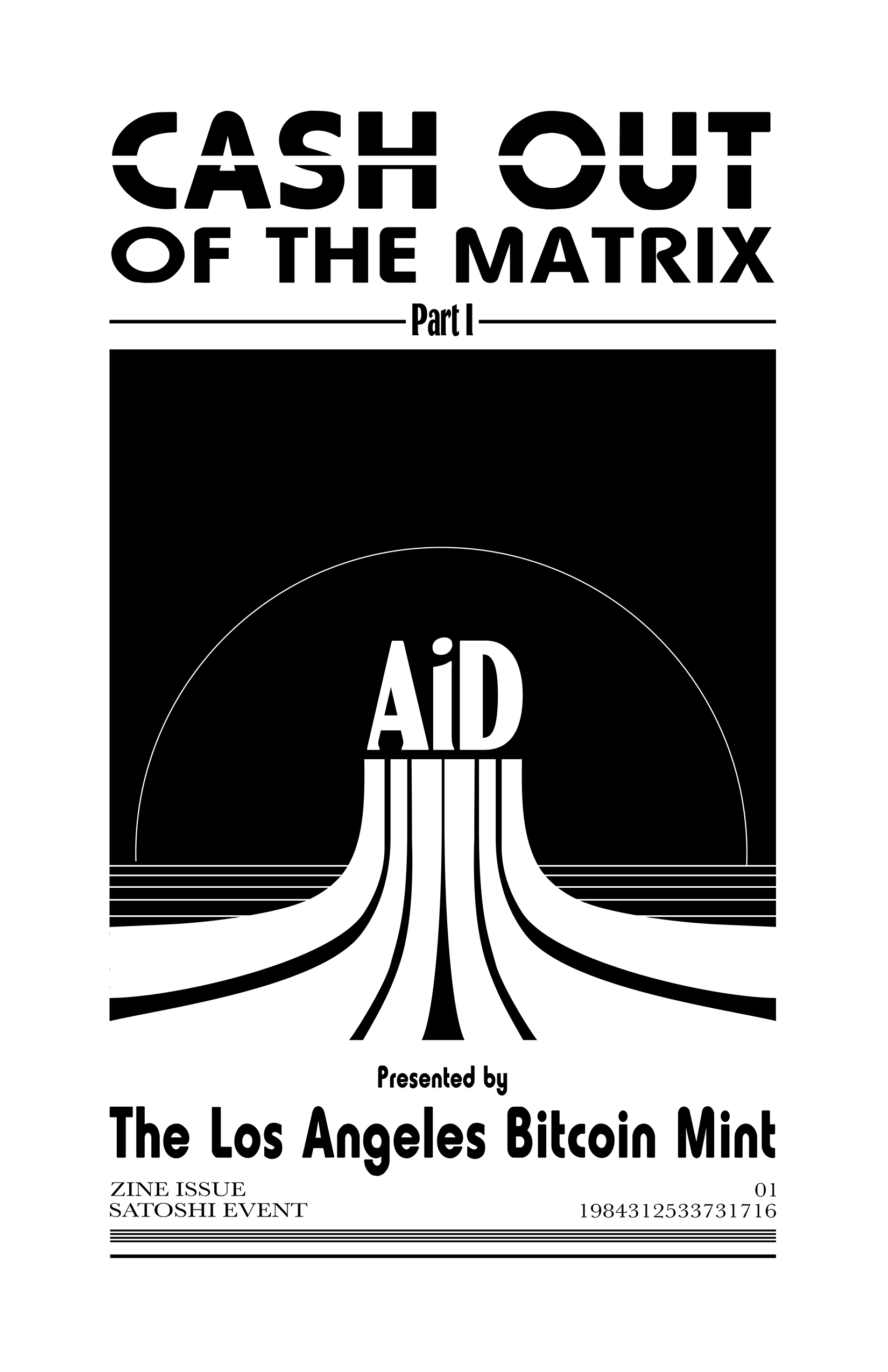
CASH OUT OF THE MATRIX PART 1
The robber barons of the matrix are at the gates, poised and ready to tokenize everything they see into a surveilled financial asset.
In part one of this series, we explain how a class of tech innovators and policy advocates are quietly transforming our economy into a tokenized ecosystem backed by Bitcoin. These barons claim that this transformation is an unstoppable force and liberation from debt-based money. But in reality, this new system will facilitate a digital mirror reality that secures state debt with the ability to track, predict and manipulate debt holders with an unprecedented level of precision. This paper proposes a path of resistance. It reveals and secures a way to cash bitcoin out of this digital machine state.
You can read the latest issue of the Los Angeles Bitcoin Mint on bitcoin or by downloading and printing it yourself.
About the collective
It is no secret that algorithms, surveillance tech and social engineering tools have co-opted the process of creating, sharing and engaging with art. They cut out new and experimental artists by suppressing online behavior that is unpredictable and that dissents, not from cultural norms but from the digital profile that algorithms have categorized artists and writers into. In other words, they suppress the organic nature that distinguishes us from machines—the propensity for change, trust and collaboration.
The Los Angeles Bitcoin Mint takes the view from Peter Kropotkin’s paper on Mutual Aid that every human is part of a social species who, when stripped of all artificial means of intermediation, is predisposed with a natural inclination to trust and cooperate with all members of the same species. We started this collective to create space for this type of unmediated creativity to flourish amidst a civilization run by systems and trustless machines.
We do this, not by abandoning digital media, but instead by using physical place and word of mouth networks as the origination of creation, collaboration and contest. In other words, we ground our collective in monthly in-person forums where members present their work and featured art to the community. Each forum will mint the featured art into physical bitcoin and publish the content discussion as a zine within the Bitcoin Ordinals collection.
Inscribing the content to Bitcoin archives the work in an uncensorable public time capsule. This archival system enables an open, decentralized means of distribution that doesn't require permission from a central publisher. Anyone can copy and reprint authentic original issues.
Connect
Subscribe to our Substack for updates on our next public form and join our mailing list for new issues of the zine.
FAQ
What are Bitcoin Ordinals
Ordinals (also called digital artifacts and bitcoin NFTS) are digital records permanently inscribed to the Bitcoin Ledger in association with individual bits of bitcoin (also called satoshis).
You can exchange Ordinals by sending the bit of bitcoin associated with the record to other addresses. And you can inscribe more content to an individual bit by attaching the content to the sending transaction. The inscription permanently associates all new and old digital records to that same bit. So, while you can expand the record, you can't delete or alter anything already recorded.
An official ordinal collection is individual bits of bitcoin inscribed with content associated with an existing "parent ordinal" in the importing transaction. This functionality allows for the cataloging of ordinals into collections and sub-collections taxonomy. Each ordinal is like a folder. It contains a digital record and can be used to create new subfolders forever nested within its catalog.
How is physical bitcoin minted to the Ordinals collection?
We mint physical bitcoin in the catalog by sending bitcoin ordinals from its collection to final destination addresses derived from irreproducible and non-counterfeitable physical material. These addresses are derived using a public standard cataloged within the collection. Anyone can prove their authenticity by repeating the process outlined in the minting standard.
Here is an example of how we will catalog the collection for CASH OUT OF THE MATRIX on bitcoin:
The Bitcoin Mint Press (parent ordinal)
>The Los Angeles Bitcoin Mint (parent ordinal)
>>CASH OUT OF THE MATRIX (parent ordinal to be closed into a physical bitcoin mint at the end of the series)
>>>Poster Art (ordinal for physical bitcoin mint)
>>>Presenting paper (ordinal for digital record)
>>>>Discussion (parent ordinal)
>>>>>Individual contribution (ordinal for a digital record and physical bitcoin mint)
[summary of an anonymized constructed comment, question or rebuttal] (digital record ^)
How is art auctioned at events?
Featured physical bitcoin art and art that people submit for future forums will be displayed on a table for the event. The featured art will be listed for a silent auction for the duration of the series. All contributor mint holders will vote for the next artist series at the end of the series.
How can I engage the project?
All attendees will have an opportunity to join the conversation. However, The Los Angeles Bitcoin Mint will not publish everything said at the event. Instead, a committee will filter out non-constructive comments and only publish content that furthers the dialog. All comments will be anonymized to protect the identity of the contributors from digital surveillance and coercion. Instead, contributors will receive a physical mint that they can use to demonstrate their contribution to people in the material world. These mints will also give them voting rights in selecting future submissions.
How can I submit art to the collective?
All submissions are first evaluated by publishing committee members and then presented to the public forum for discussion. Anyone who wants to show art and a paper for future publication can offer their art for consideration by showcasing it at the auction table.
How is the zine distributed?
The Los Angeles Bitcoin Mint will publish copies of its collection as issues of a paper zine mailed to subscribers and sold through local vendors. The goal is to emphasize physical peer-to-peer distribution channels over the surveillable digital ones. This emphasis will encourage other people to engage and share the content in unmediated human space.
Secondly, the zine's immutable inscription to the Bitcoin Ledger opens up decentralized redistribution opportunities. Anyone who wants to copy and share the content can use that inscription to verify its fidelity to the original in-person conversation.
This publication and distribution system is a new paradigm that takes time and conversation to really take in. Unlike the surveillance model, clicks and engagement metrics don't measure its value. And unlike the traditional model, the value exchange isn't managed through established distribution channels. Instead, it is measured and exchanged in the unmediated space of collaboration and cooperation. The rules and format of its design are still a work in progress. So, if you want to help shape the future of this project, come to its first event and share your ideas!